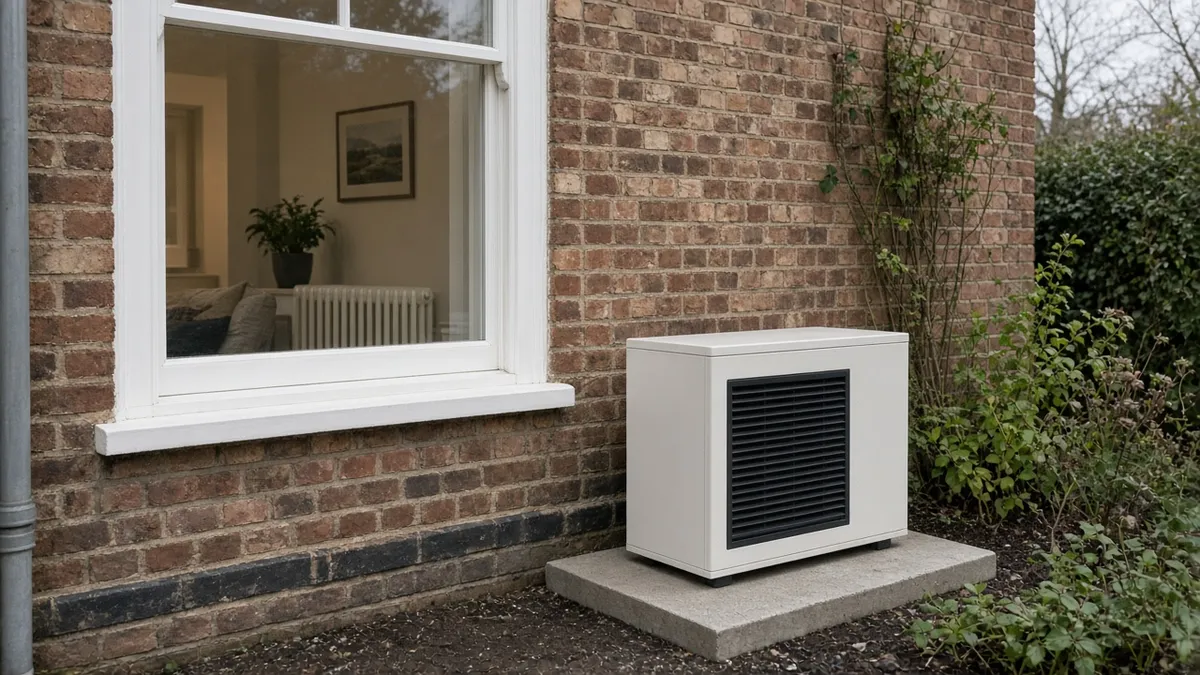
If your house is already heated by hot water — radiators, baseboards, or a radiant floor — an air-to-water heat pump can look like a simple swap. Take out the boiler, put in a heat pump, and keep the pipes you already have. In a new, well-insulated house with a low-temperature floor system, that can be close to the truth. In an older home, it usually is not. The heat pump can work very well, but only if the rest of the heating system is ready for it.
How an air-to-water heat pump actually works
An air-to-water unit sits outside and pulls heat from the outdoor air, even on cold days, then transfers that heat into a loop of water. The water travels through your existing distribution system and warms the rooms. Many systems can also heat domestic hot water, and some can run in reverse to provide cooling through fan coils or a hydronic air handler.
This is different from an air-to-air heat pump, which uses ducts, and from a ground-source heat pump, which exchanges heat with the soil. Air-to-water equipment is attractive because so many existing homes already have a hydronic system and no useful ductwork.
The catch is water temperature. A conventional boiler often sent water out at 160°F to 180°F (about 70°C to 80°C). Most air-to-water heat pumps are at their best when they supply much cooler water, often in the 95°F to 130°F range (about 35°C to 54°C). Some units can push hotter water, but efficiency falls as the target temperature rises.
The water temperature problem in older homes
Radiators and baseboards in older houses were usually sized for that hotter boiler water. If you drop the supply temperature by 40 or 50 degrees, the same metal may not put enough heat into the room on the coldest days of the year. The heat pump may also cycle poorly, or trip off, if the distribution system cannot get rid of heat as fast as the unit is adding it.
That is why a serious retrofit starts with a room-by-room heat-loss calculation, not with the nameplate size of the old boiler. Boilers were often oversized. What matters is how much heat each room actually needs after any insulation or air-sealing work, and how much the existing emitters can deliver at the water temperature the heat pump will use.
If the numbers fall short, you have options. You can add heat: high-output baseboard, larger panel radiators, a hydronic fan coil, or supplemental radiant tubing. You can cut the load with insulation, better windows, and air sealing, which may let the existing emitters work at a lower temperature. Or you can keep the old boiler as a backup and let the heat pump handle the milder weather that makes up most of the heating season. That hybrid approach is often the most practical path in a cold climate.
Efficiency in the real world, not on the label
A heat pump’s coefficient of performance, or COP, is the heat it delivers divided by the electricity it uses. A COP of 3 means three units of heat for each unit of electricity. Catalog ratings can look excellent in mild conditions. Field results are more modest, and they depend on outdoor temperature, the required water temperature, defrost cycles, and how well the controls are set up.
In colder U.S. climates, monitored air-to-water systems have often shown seasonal or daily COPs around 2 to 3 for space heating, with higher figures on milder days and lower figures when the unit is also making domestic hot water. In milder climates, well-designed systems have been measured in a higher range, sometimes above 4. Poor commissioning can cut those numbers sharply. One cold-climate case study found that mismatched controls could reduce COP by half.
Treat the brochure COP as a starting point, not a guarantee. Ask the designer what seasonal efficiency they expect at your winter design temperature and at a water temperature your emitters can actually use.
What a retrofit usually involves
A typical project is more than setting an outdoor unit on a pad. The installer may add a buffer tank, new pumps, mixing or outdoor-reset controls, and a revised piping layout. Domestic hot water may need its own tank or an indirect cylinder sized for the heat pump. The electrical service sometimes has to be upgraded. Outdoor placement matters too: the unit needs airflow, a place for defrost meltwater to drain, and enough distance from bedrooms and neighbors because it will make some noise.
Costs, incentives, and when a hybrid system makes sense
Installed costs vary too much for a single national price. For a straightforward retrofit that reuses a compatible hydronic loop, published U.S. ranges in recent trade estimates often fall somewhere around $12,000 to $28,000. Projects that replace radiators, add tanks, upgrade the electrical panel, or rework piping can cost more. Treat those figures as rough planning ranges, not bids.
The federal Energy Efficient Home Improvement Credit (section 25C), which had helped with qualifying heat pumps, is not available for property placed in service after December 31, 2025. State, utility, and local rebates may still apply, and they differ sharply by location. Check those before you compare a heat pump with a new boiler on operating cost alone.
Operating cost depends on your electricity rate, the price of the fuel you would have burned, and the real seasonal COP. In some places, an air-to-water heat pump clearly undercuts oil or propane. Against cheap natural gas, the bill savings can be smaller or disappear, even when the heat pump uses less energy overall. A hybrid system can still cut fuel use for most of the year while leaving the boiler in place for design-day cold snaps.
Questions to ask before you commit
Before you sign, ask for the design supply-water temperature at your local winter design condition, a room-by-room comparison of heat loss versus emitter output at that temperature, the expected seasonal COP, and a clear plan for backup heat. Ask who will commission the controls, and how domestic hot water will be handled on the coldest mornings. If the proposal is simply “replace the boiler with a heat pump and leave everything else alone,” keep asking.
An air-to-water heat pump can be an efficient way to heat an existing hydronic home. The homes that do well with one are the homes whose owners treated the pipes, the radiators, and the building envelope as part of the system, not as background furniture the new outdoor unit would somehow ignore.