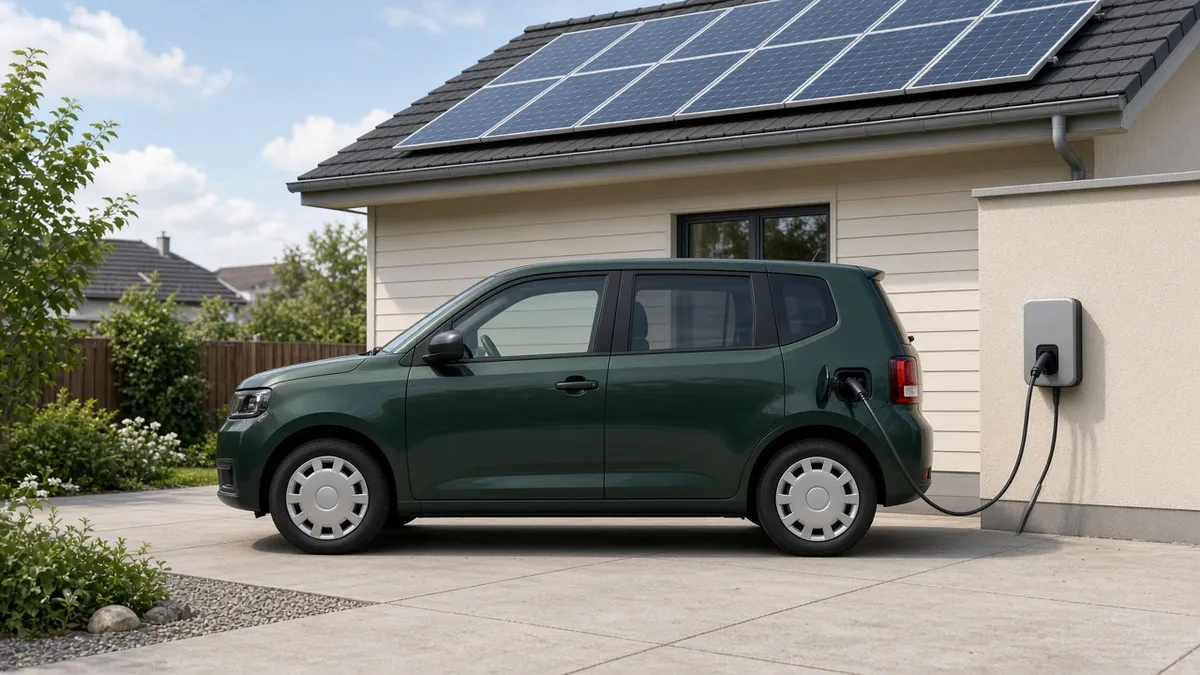
One of the more satisfying ideas in home energy is also one of the easiest to oversimplify: put solar panels on the roof, plug in the car, and drive on sunshine. In a loose, year-long sense, that can be true. In a strict, hour-by-hour sense, it often is not. The car may charge at night. The panels produce power in the middle of the day. The grid, a home charger, and sometimes a battery sit in between. Understanding that timing is what turns a nice idea into a system that actually fits your driving.
How much electricity an EV actually uses
Most electric cars use about 0.25 to 0.35 kilowatt-hours per mile, once you allow for weather, highway speeds, and charging losses. A planning figure of about 0.3 kilowatt-hours per mile is a reasonable middle. That means 12,000 miles a year, close to a typical U.S. driving total, needs roughly 3,000 to 4,000 kilowatt-hours.
For many households, that is a 25 to 40 percent jump in electricity use. If you size an array only for the house and then add a car later, you will buy more grid power than you expected, even if the panels are working perfectly. Use your car’s trip data or the window-sticker figure, then add a little margin rather than planning around a perfect summer commute.
How much extra solar you need
You do not need a special “EV solar kit.” You need additional annual production that matches the electricity the car will use. A well-sited kilowatt of rooftop solar in the United States often produces roughly 1,200 to 1,800 kilowatt-hours a year, depending on climate, roof direction, and shade.
At that rate, offsetting about 3,500 kilowatt-hours of driving usually takes something on the order of 2 to 4 extra kilowatts, or about six to ten 400-watt panels. This is on top of the array that covers the house.
That is the annual math. It answers the question, “Over a year, can my roof generate as much electricity as my car consumes?” It does not mean the car is drawing power from the panels at the moment you plug it in.
Charging during the day versus at night
Most people still charge at home overnight. The car sits in the driveway after work, and a Level 2 charger fills it while they sleep. The solar array, meanwhile, did its work while they were away. If your utility offers traditional net metering, the surplus you exported at noon can offset the power you take back at midnight, kilowatt for kilowatt, or close to it. In that case, “charging with solar” is really an accounting result, and it can work very well.
If the utility pays much less for exported power than it charges in the evening, overnight charging is less tidy. Then it pays to move charging into daylight hours when you can: a work-from-home schedule, a lunchtime top-up, or a charger that starts when the array is producing surplus power. Some chargers can follow solar output and raise the share of driving powered directly by the panels.
A home battery can store midday solar and discharge it into the car after dark. That is the cleanest way to make overnight charging truly solar-powered, but it adds cost. It is most useful when export credits are poor or when you already want a battery for backup.
Level 1 and Level 2 charging at home
Level 1 charging uses a standard 120-volt household outlet and the portable cord that usually comes with the car. It typically adds about 3 to 5 miles of range per hour. For a short commute, that can be enough. For a larger car battery or a longer day, it is slow.
Level 2 charging uses a 240-volt circuit, the same voltage as a dryer or range, and a wall-mounted charger. It often adds about 20 to 30 miles of range per hour, depending on the car and the circuit rating. A common home charger is around 7 kilowatts; some are higher.
Both levels can work with solar. Level 2 simply asks more of your electrical panel and, if you want to charge directly from the roof, more surplus solar at that moment. A 7-kilowatt charge rate is hard to cover with a small array once the house is also using power. Many households still do most of their charging in the evening and let annual solar production, or net-metering credits, make up the difference. An older panel may need capacity before you add both a charger and a larger solar inverter, so it is cheaper to plan those loads together than to upgrade the panel twice.
Batteries, the grid, and what “solar charged” really means
Unless you live off the grid, your house stays connected to the utility. When the car needs more power than the roof is producing, the grid fills the gap. When the roof produces more than the house and car can use, the surplus goes out to the grid, into a battery, or both. That is how almost every home solar system works.
What changes is the value of that surplus. Full net metering makes the grid feel like a very large, very cheap battery. Weaker export rates make self-consumption more important. The car is a useful load to add, because some of that charging can be moved to sunny hours. Be wary of claims that a handful of panels will “power your car for free” with no reference to mileage, climate, or utility rules.
A practical way to plan the setup
Start with your real driving, not a brochure average. Multiply annual miles by about 0.3 kilowatt-hours per mile, then add a margin for winter and charging losses. Add that figure to the household electricity use on your utility bills. That combined total is what a solar system should aim to produce if you want the car included. Then decide when the car will usually charge, what your utility pays for exports, and whether a Level 2 charger, a solar-aware charging mode, or a battery is worth the extra cost.
You can charge an electric car with your own solar panels. The panels do not have to be wired straight into the vehicle, and the sun does not have to be out at 10 p.m. What you need is enough annual production, a charger that fits your routine, and a clear-eyed look at how your utility treats the power that flows in both directions.