Ask three neighbors what they paid for rooftop solar and you may hear three very different numbers. That is not a trick. In 2026, the price of a home photovoltaic system still depends on where you live, how large the array is, what the roof needs, and which figure someone is quoting. The useful skill is not memorizing a single national average. It is knowing what a cost-per-watt number includes, and what it quietly leaves out.
The numbers you will actually see on a quote
Installers usually price a system in dollars per watt. Divide the total cash price by the system’s size in watts and you can compare an 8-kilowatt quote with a 12-kilowatt quote on a fair basis. If an 8,000-watt system is priced at $20,800, that is $2.60 per watt.
Two widely cited 2026 figures sit side by side and are easy to mix up. Quotes collected on the EnergySage marketplace in the first half of 2026 had a median around $2.57 per watt before incentives, with many offers falling roughly between $2.38 and $2.94 per watt. A national turnkey benchmark from the Solar Energy Industries Association and Wood Mackenzie, based on a modeled cost buildup rather than a set of consumer quotes, was about $3.36 per watt in mid-2026. Completed-project data in other industry reports has often landed somewhere between those two. None of these is “the” price of solar. They are different ways of measuring a market that still varies a lot from state to state.
Using those ranges as a planning guide, not a bid, a 6-kilowatt system might cost roughly $15,000 to $20,000 at marketplace-style prices, or around $20,000 at the higher national benchmark. An 8-kilowatt system might cost roughly $19,000 to $24,000, or around $27,000 at the benchmark. A 10- to 12-kilowatt system might cost roughly $24,000 to $36,000, or about $34,000 to $40,000 at the benchmark. Regional gaps are wide. In the same marketplace data, median quotes in some lower-cost states were near $2.00 per watt, while a higher-cost state could exceed $3.00.
These figures are for the solar system itself, before incentives and before a battery. A battery is a separate line item and should not be folded into a cost-per-watt comparison with a solar-only quote.
What you are paying for besides the panels
The modules on the roof are only a slice of the bill. In typical 2026 breakdowns, the panels themselves often account for around 10 to 18 percent of the total installed price. Wholesale module pricing for the distributed market has been reported near $0.37 per watt, or roughly $150 for a 400-watt panel at installer cost. A retail panel bought one at a time costs more, but that is not how most home systems are sold.
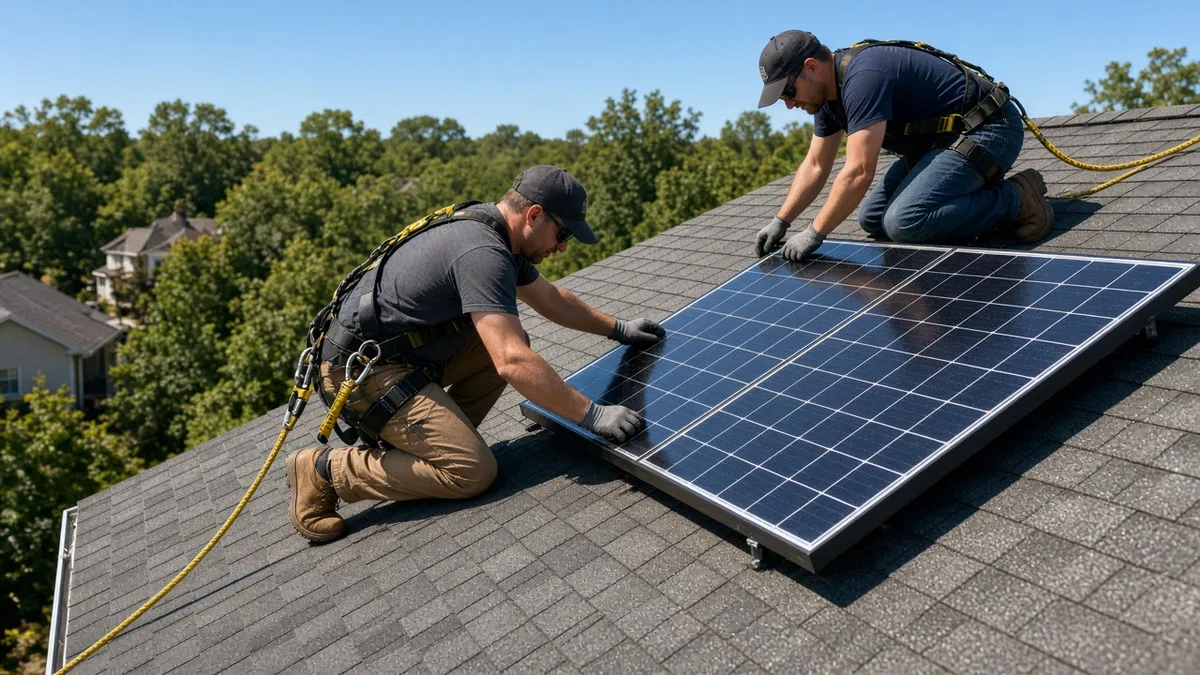
The rest of the money goes to inverters, which turn the panels’ direct current into household alternating current; racking, flashing, wiring, conduit, and other electrical parts; labor to attach the array and commission the system; permits, inspections, and the utility interconnection; and design, sales, overhead, and the installer’s margin. Hardware and labor together often make up less than half the price. The rest is “soft costs.” That is why two quotes for similar equipment can still be thousands of dollars apart, and why a cheaper panel rarely transforms the total. It is also why a very low bid deserves a closer look at what has been left out.
System size, roof, and location
Most households still land in a range of about 6 to 12 kilowatts, depending on how much electricity they use, how much roof they have, and whether they are planning for an electric car or a heat pump later. Bigger systems usually cost more in total but a little less per watt, because design, permits, and a site visit are fixed costs that get spread over more modules.
The roof itself can move the price as much as the equipment list. A simple, recently replaced south-facing composite roof is cheaper to work on than a steep, cut-up, shaded, or aging roof. Tile, metal, or slate can add labor. If the shingles are near the end of their life, it is usually wiser to reroof first than to pull a ten-year-old array off later. Ground-mount systems avoid some roof issues but add racks, trenching, and often a higher total cost.
Sunlight matters for value, even when it does not change the hardware price. A well-sited kilowatt in the United States often produces roughly 1,200 to 1,800 kilowatt-hours a year. The same array is worth more, year after year, in a sunny location with high electricity rates than in a cloudy one with cheap power.
Extra costs that do not show up in a headline price
The number on the first page of a proposal is not always the number you will pay. Ask about main-panel upgrades, which are common in older homes; roof repairs, reroofing, or tree work; trenching or a long conduit run; sales tax, permit fees, and any utility charges; and loan dealer fees. A financed price can look similar to a cash price until those fees are built in. Always compare the cash price first.
In 2026, homeowners who buy and own a new system generally cannot claim the old 30 percent federal Residential Clean Energy Credit, which ended for expenditures made after December 31, 2025. State and utility incentives may still reduce the net cost. Financing, leases, and other contract types can change the cash you put down, but they do not change the need to understand the underlying system price.
How to compare quotes fairly
Ask at least three installers for the same target size, and line up the quotes on cash price, dollars per watt, equipment, warranty, and estimated first-year production. Confirm whether roof work, a panel upgrade, or a battery is included. Check the workmanship warranty as well as the panel and inverter warranties. A slightly higher price can be the better buy if the production estimate is more realistic, the roof details are handled, and the company will still answer the phone in year eight.
Rooftop solar in 2026 is still a sizable home improvement, not a mystery product with one official price. Once you read a quote as a bundle of equipment, labor, and soft costs, the number on the page becomes much easier to judge.